30/03/2026
Wave Springs: the space-saving solution for demanding engineering applications
RPK Group engineers and manufactures custom wave springs for automotive, medical, industrial, and e-mobility applications, combining more than 50 years of expertise with a global manufacturing footprint
By Fernando Gonzalez, product engineer at RPK Technological Center.
A product engineer with more than 25 years of experience in the group, an expert in developing new products, in particular springs and new products for the automotive and medical sectors.
What Is a Wave Spring?
A wave spring is a precision-engineered component made from flat wire coiled on edge into a series of uniform waves. It delivers the same axial load as a traditional coil spring in up to 50% less space.
That difference is significant. As design envelopes shrink across every industry, engineers need components that perform without taking up space. Wave springs solve that problem directly. They sit where coil springs cannot fit, without sacrificing load consistency or fatigue life.
RPK Group has been engineering springs since 1974. We don't just manufacture them; we help engineers select, design, and validate the right component for their specific application.
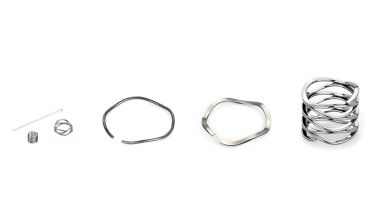
Types of Wave Springs
Not every application calls for the same design. Wave springs come in several configurations, each suited to different load requirements, deflection ranges, and space constraints. Choosing the right type is the first engineering decision and it's one where RPK's team adds real value.
A single coil with either a gap or an overlap at the ends. Compact radially, with short deflection travel. Best for low to medium loads where axial space is tight and the application needs a consistent preload.
Typical use: bearing preload, seals, light-duty actuators
Multiple turns of flat wire are coiled so the wave crests align across layers. The spring rate decreases as the number of turns increases, allowing engineers to achieve low to medium spring rates over large deflections. Replaces coil springs at up to 50% less axial height.
Typical use: valves, actuators, transmissions, drug delivery devices
A multi-turn wave spring with flat, squared ends machined or formed at both terminations. Shim ends provide a 360° contact surface with mating components rather than point contact, distributing the load more evenly and reducing surface stress.
Typical use: precision assemblies where load distribution and seating matter
Two or more wave springs coiled concentrically from a single continuous wire and stacked in parallel. Spring rate increases proportionally with the number of turns, generating high forces in a short axial space. Replaces stacks of Belleville washers where precise load control is needed.
Typical use: high-load hydraulic systems, clutch packs, aerospace actuators
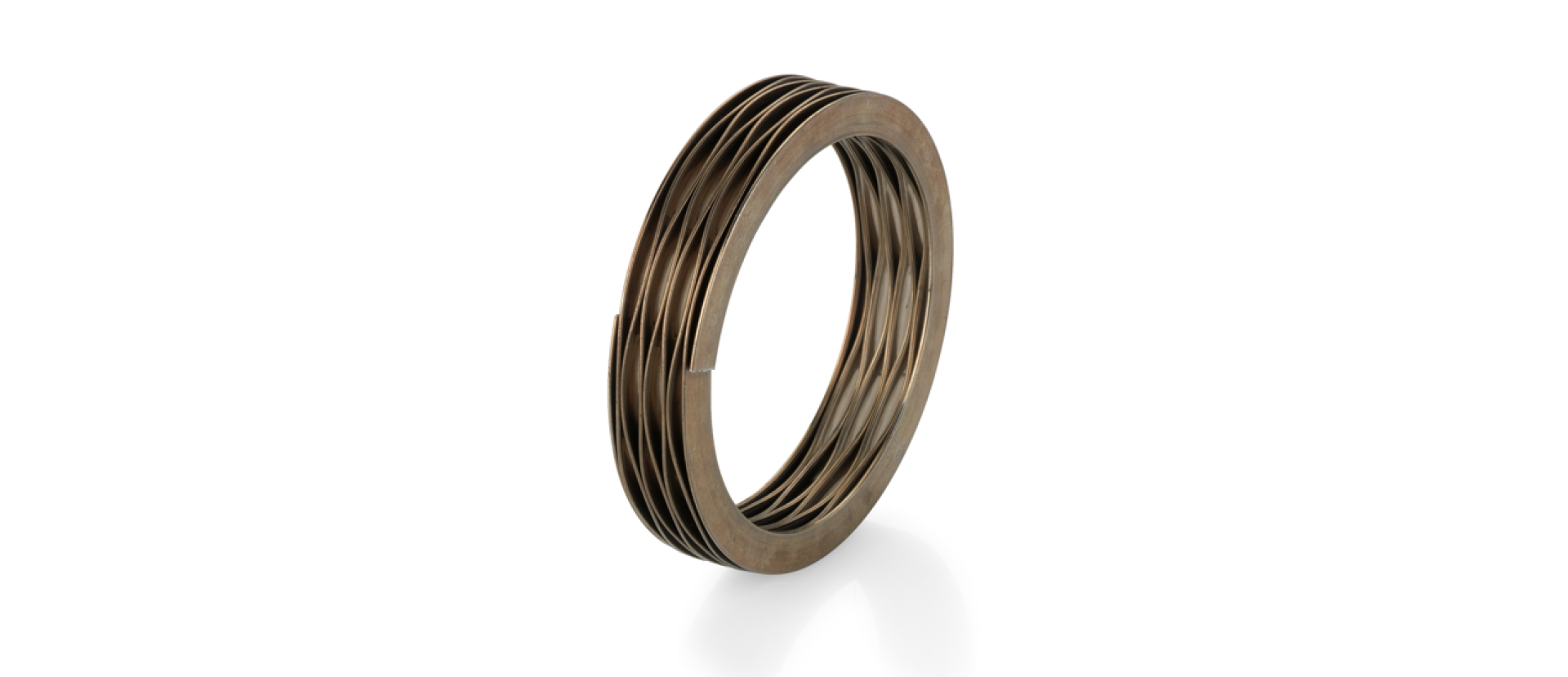
Two multi-turn wave springs wound together so their turns intermesh throughout the full length. Interlacing effectively doubles the wire thickness per turn, increasing load capacity and fatigue resistance while maintaining the same outer envelope as a single spring.
Typical use: high-cycle fatigue applications, precision load control at elevated forces
A wave spring lay out in a straight line rather than coiled into a ring. Used in straight channels, tracks, or housings where circular geometry is not possible. Provides the same load and deflection behavior as circular types but in a linear format.
Typical use: linear guides, sliding mechanisms, connector contacts
RPK Group manufactures all of these configurations, including right-hand and left-hand wound versions, across every type of capability that no other wave spring manufacturer offers.
The real problems engineers face when specifying springs
Specifying the wrong spring can lead to costly rework. These are the problems we hear from engineers every week:
- No space left. Assembly housings keep getting smaller. Standard coil springs don't fit, but the load requirement remains the same.
- Inconsistent load-stamped. Some washers look similar to wave springs, but their load-at-height tolerances are wide and unpredictable. In medical devices or automotive actuators, that's a failure risk.
- Material dead-ends. Applications in corrosive, high-temperature, or biocompatible environments require Inconel, Elgiloy, or Nitinol. Most suppliers can't source or form these alloys to the required precision tolerances.
- Supply chain gaps. A supplier that only covers one region leaves your production line exposed. You need a partner who can manufacture close to your plant, wherever it is.
- No engineering support. Most buyers get a catalog, not a conversation. Substituting a coil spring for a wave spring requires load analysis, material selection, and tooling validation, which need an engineering partner, not just a part number.
Why engineers choose RPK Group for wave springs
"RPK Group is the only manufacturer in the world that produces both right-hand and left-hand wound wave springs"
That matters in assemblies where torque direction, rotation, or interference with adjacent components constrain the winding direction. No other supplier gives engineers both options.
Here is what else sets RPK apart:
- Vertical integration: We roll our own flat wire in-house. That means tighter material control, shorter lead times, and no dependency on third-party wire suppliers.
- Co-development: Our engineers work alongside yours from feasibility studies through serial production. We run load simulations, validate tooling, and support PPAP and design reviews.
- Full material range: Stainless steel, carbon steel, Inconel, Elgiloy, Nitinol, and more. Wire thickness from 0.10 mm to 2.5 mm. If the alloy exists in flat wire form, we can work with it.
- Medical-grade capability, ISO 13485 certified. ISO 7 clean rooms on three continents. We manufacture wave springs for drug delivery devices, surgical instruments, and minimally invasive tools.
- Global local supply: Manufacturing plants in Spain, Mexico, China, and India. We produce close to your assembly line — reducing lead times, freight risk, and import complexity.
Wave springs across industries
RPK Group wave springs are running in production environments across four major sectors:
Powertrain actuators, suspension, hydraulic valves, and transmission components. Space is critical. Load consistency is non-negotiable. IATF 16949 quality system.
Battery management systems and motor assemblies demand weight savings and tight tolerances. Wave springs reduce mass and stack height simultaneously.
MDI, DPI, and SMI inhalers, autoinjectors, surgical instruments, and minimally invasive tools. Clean room production and full material traceability are standard.
Hydraulic and pneumatic valves, bearings, and linear actuators. Wave springs deliver precise, consistent load curves, whereas coil springs introduce too much variability.
Wave springs are also used in power tools, where installation space is limited and mechanical reliability is essential. At RPK Group, we work with leading power tool manufacturers, including major American brands, developing components for applications in tools such as drills, saws, and impact drivers.
Hubs, bearings, and electric motors. Wave springs help control preload, reduce axial play, and optimize space in high-performance systems.
For high-load applications in confined spaces, RPK Group also manufactures nested wave springs, two or more wave springs stacked concentrically to multiply load capacity without increasing axial height.
Certifications and standards
RPK Group holds ISO 9001, ISO 13485, and IATF 16949 certifications across its global manufacturing network. Our clean rooms meet ISO 7 (Class 10,000) requirements for medical device manufacturing in Europe, North America, and Asia.
Every wave spring we produce comes with full material traceability and, where required, dimensional reports, FAI, and PPAP documentation. We work within your quality system, not around it.