16/03/2026
Spring co-design: a competitive advantage in the automotive industry
From the initial stages of development allows for optimizing their performance, reducing risks and avoiding failures, becoming a key competitive advantage in the automotive industry
By RPK Technological Center Engineering
The most reliable springs are developed through collaboration from the very beginning of the project.
In many automotive developments, spring design is addressed too late. The supplier receives a finalized drawing and is limited to manufacturing the part. At that stage, the opportunity for improvement is very limited.
However, a spring’s behavior depends on multiple variables. Geometry, material, heat treatment, dynamic loads, operating temperature, and available space all directly affect its performance.
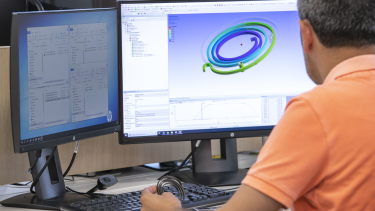
Simulation and co-design make the difference
When these factors are analyzed during the early stages of product design, it becomes possible to iterate solutions such as:
- Adjusting force characteristics
- Optimizing spring fatigue life
- Reducing the space required for the component
By contrast, when the supplier becomes involved only in later stages of the project, issues often appear during validation:
- Fatigue failures
- Load loss
- Mechanical interferences
- Unexpected spring vibrations
In the automotive industry, where development cycles are growing shorter and systems are becoming more compact, co-design and simulation with the spring manufacturer have become essential practices.
RPK Group: 50 years solving engineering challenges in springs
RPK Group is a manufacturer with more than five decades of experience in the design and production of springs, stamping parts, bus bars, and highly complex metal components.
Since its origins, the company has worked with highly demanding industrial sectors. Among them, the automotive industry plays a central role due to its high technical and quality standards.
Over the years, RPK Group has developed a distinctive capability: solving complex engineering problems related to elastic metal components.
It’s not just about manufacturing parts. It’s about understanding how the spring behaves within the complete system.
Our engineering team analyzes loads, duty cycles, environmental conditions, tolerances, and space constraints. Based on this analysis, the optimal solution is defined in terms of geometry, material selection, and manufacturing process.
This technical approach helps our customers reduce risks during product development and improve the reliability of the final system.
The challenge of finding suppliers who collaborate from the start
In practice, many automotive companies still work with suppliers that operate strictly as manufacturers.
This model works when parts are simple. But when the spring plays a critical functional role, its limitations quickly become apparent.
A spring may seem like a simple component. However, its mechanical behavior depends on complex factors such as:
- Stiffness
- Working load
- Material relaxation
- Fatigue cycles
- Vibrations
- Interaction with surrounding components
When the design is finalized without analyzing these variables with the manufacturer, problems typically emerge during validation.
Current industry trends make early collaboration even more important. According to industrial engineering studies, approximately 70–80% of a product’s total cost is defined during the early design stages.
At the same time, vehicle electrification is increasing system complexity. New actuators, electrical connectors, sensors, and compact mechanisms require increasingly precise metal components.
In this context, the ability to iterate designs through simulation and co-development becomes a clear competitive advantage.
However, not all suppliers have the engineering resources needed to actively participate in these early development stages.
Why RPK Group is a valuable engineering partner
If your team is developing a new automotive system and needs to integrate springs or other metal components that meet demanding requirements, RPK Group can collaborate from the earliest stages of the project.
Our engineering team analyzes each application in detail and works with customers to define robust, industrially viable solutions.
Working with RPK Group provides technical value from the beginning of the development process:
- Early project involvement
We collaborate with customer engineering teams to define the spring's functional behavior from the start. - Simulation and technical analysis
We analyze loads, deformation, fatigue cycles, and environmental conditions to optimize component design. - Rapid design iteration
The integration between engineering and manufacturing allows us to quickly adjust designs and validate alternatives. - Space and performance optimization
We design springs that perform reliably even in compact applications or tight-tolerance environments. - Reduced validation risks
Early analysis minimizes late design changes, development delays, and issues during testing phases.
Frequently asked questions about spring co-design and simulation in automotive
Why is it important to involve the spring manufacturer early in the project?
Because many critical spring variables are defined early in the design process. Early collaboration allows optimization of geometry, material selection, and mechanical behavior.
What problems can be avoided through co-design?
Fatigue failures, force loss, mechanical interference, unwanted vibrations, and late redesigns during validation.
What role does simulation play in spring design?
Simulation enables engineers to analyze loads, deformations, and component lifespans before manufacturing prototypes, reducing development time and technical risk.
In what types of projects is co-design most critical?
Especially in compact applications, systems with very long life cycles, or environments with demanding temperature and vibration conditions.
What is the difference between a manufacturing supplier and an engineering partner?
A manufacturer produces parts based on drawings. An engineering partner participates in the design process to improve the performance of the complete system.