25/05/2026
Canted coil springs and garter springs: which one does your application need?
RPK Group designs and manufactures both spring types for the world's most demanding industries: medical, aerospace, oil & gas, electrical, and automotive. We help you choose the right solution and build it to spec.
By Fernando Gonzalez, Rubén Díaz, engineers at RPK Technological Center, and Álvaro García Nograro, KAM for Canted Coil Springs Projects at RPK Group and Egoitz Crespo, sales engineer at RPK Group Tarragona
Engineers specifying spring-energized seals, electrical connectors, or retention mechanisms face a recurring question: canted coil spring or garter spring? The answer depends on load precision, the operating environment, and the application's cost constraints. This article lays out the technical differences, common use cases, and the factors that determine which spring performs better in your design.
What is a garter spring?
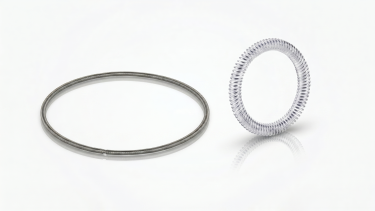
A garter spring is a helical coil formed into a closed ring, with its two ends joined; typically by hooking or threading them together. The ring applies a continuous radial force inward or outward, depending on whether it is a compression or tension spring. Garter springs are inexpensive to produce, and their simple geometry makes them a reliable choice for standard sealing and retention tasks.
Typical applications: rotary oil seals, automotive transmission systems, shaft seals, and any assembly that needs uniform radial pressure around a circular surface at moderate loads.
What is a canted coil spring?
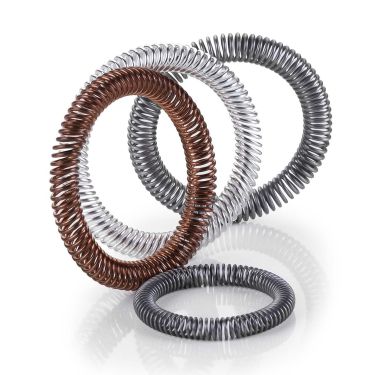
A canted coil spring is also ring-shaped, but its coils are inclined at an angle — "canted" — relative to the spring axis. The ends are laser-welded, not hooked. That inclined geometry produces a near-flat force curve: the spring delivers consistent contact pressure over a wide range of deflection, both radially and axially. You can tune the spring's force profile by adjusting the wire diameter, coil height, coil spacing, and the cant angle.
Typical applications: high-reliability electrical connectors, PTFE and polymer seal energizers, EMI shielding, aerospace and medical device retention, oil and gas downhole tools, and any assembly where stable contact force and long fatigue life are mandatory.
Canted coil springs vs. garter springs: key differences
| Attribute | Garter Spring | Canted Coil Spring |
|---|---|---|
| Force curve | Progressive (force increases with deflection) | Near-flat (constant force over broad deflection range) |
| Load precision | Moderate | High; engineerable to tight tolerances |
| Deflection direction | Radial only | Radial and axial |
| Electrical conductivity | Not designed for it | Yes, each coil acts as a contact point |
| Fatigue life | Good for low- to mid-cycle applications | Excellent; resists coil set even under high cycles |
| Environmental resistance | Standard materials | High; platable, compatible with extreme temperature, pressure, chemicals |
| End join method | Hook or thread | Laser-welded for clean, consistent geometry |
| Typical cost | Lower | Higher; justified by performance requirements |
| Best fit | Standard seals, automotive, moderate loads | Aerospace, medical, EV connectors, oil & gas, high-precision seals |
Force vs. deflection: garter spring vs. canted coil spring
Garter spring — use when
- Standard rotary / shaft seals
- Moderate loads, cost-sensitive
- No electrical function needed
Canted coil spring — use when
- Precision force over wide deflection
- Electrical contact / EMI shielding
- Aerospace, medical, oil & gas, EV
What Engineers and Buyers Get Wrong When Choosing
The most common mistake is using a garter spring where a canted coil spring is needed, and vice versa. Garter springs are the right choice for low-cost, standard-load sealing tasks. But when an application involves extreme pressure, vibration, electrical contact, or tight force tolerances, a garter spring will underperform. The cost of a failed seal or intermittent electrical connection far outweighs the price difference between the two spring types.
On the other side, specifying a canted coil spring for a basic rotary seal with no precision load requirement adds unnecessary cost. The right call depends on a clear analysis of load range, cycle count, operating environment, and whether the spring must also serve an electrical function.
Other pain points engineers report to us:
- Suppliers without in-house engineering support are forcing design decisions without real technical input.
- Long lead times for custom geometries due to the supplier's lack of dedicated production lines.
- Inconsistent spring force across production batches, causing seal failures or connector dropouts in the field.
- Limited material options, especially for canted coil springs that require specific plating for conductivity or corrosion resistance.
Why Engineers Choose RPK Group
RPK Group has manufactured precision springs in Europe since 1974. We produce both canted coil springs and garter springs on dedicated production lines, with in-house engineering teams and global manufacturing capacity across Spain, Mexico, India, and China. We don't just catalog springs, we engineer them.
- Dedicated production lines for garter springs and canted coil springs; not treated as a sideline product.
- Laser-welded spring ends on canted coil springs for precise, repeatable geometry and cleaner electrical contact.
- Custom plating options (gold, silver, nickel) to optimize conductivity, corrosion resistance, or both.
- In-house engineering support; our team fine-tunes wire diameter, coil height, cant angle, and force profile for your exact application.
- ISO 7 clean rooms in Europe, North America, India, and China facilities for medical and high-precision applications.
- Proven track record with Tier 1 automotive OEMs and medical device manufacturers.
- Global supply chain: two factories in Spain plus production in Mexico, India, and China to meet volume and lead-time requirements.
- 50+ years of manufacturing springs: the experience shows in every batch we deliver.
Materials We Work With
For garter springs, we manufacture in carbon steel, stainless steel, and Ti stainless steel. For canted coil springs, we work with a wider range of materials to meet electrical, chemical, and temperature requirements, including high-performance alloys and plated finishes that standard suppliers cannot offer.
Industries We Serve
Our canted coil springs and garter springs go into systems across:
- Aerospace: pressure seals, retention mechanisms, vibration-resistant connectors.
- Medical devices: implantable components, precision seals, clean-room-manufactured parts.
- Oil and gas: downhole tool seals, high-pressure applications, chemically aggressive environments.
- Electric vehicles and mobility: high-current connectors, battery system seals, EMI shielding.
- Industrial automation: actuators, valve seals, pneumatic and hydraulic systems.
- Automotive: rotary seals, transmission systems, braking, and injection components.